
PART ONE
From the aftermath of the First World War to the eve of another — family history, class, childhood, fascism, peace, politics and the world into which Ron Johnson grew up.
THE FIRST PART OF THE STORY
Part One of Ordinary Giants begins in 1918 and follows the years between the two world wars, through the childhood and youth of Ron Johnson and the changing political and social landscape around him.
The songs move between family stories and wider history: the aftermath of the First World War, suburban west London, poverty and class, Gandhi, fascism, Cable Street, the desire for peace and the gathering certainty of another war.
IMAGES FROM PART ONE

Jenny Carr
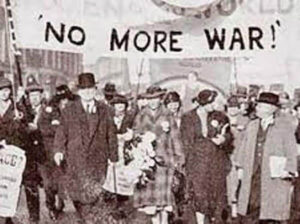
Armistice — No More War
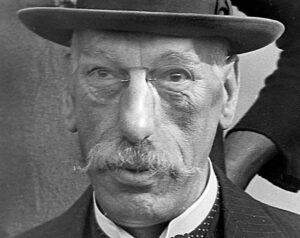
Sir Henry Norris
TRACK LIST
Seventeen pieces take the story from the end of the First World War to September 1939.
- Giants
- A Land Fit for Heroes
- The Mysteries of Fulham
- Pretty Maids in Tin Cans
- Slow Progress 1929
- The Hang of the Door
- Here Comes Mr Gandhi
- Did You Go to Eton? 1934
- Holding Hands with Hitler
- Where You Go Depends on Where You Come From
- Lou 1936
- Have You Heard the News? 1936
- The Gentlemen of the Chorus
- One More War
- Welcome Him Home
- Kitty and Me
- September's Song
THE SONGS & THEIR STORIES
Robb's notes on the songs, people and historical events that make up Part One. Open each title to read the story.
1. Giants (Overture)
I noticed that often, proper musical theatre has overtures that set the mood, anticipate themes and get the whole thing in motion.
So I thought I’d have one too.
Jenny Carr’s beautiful elegiac piano playing from September’s Song was already providing a theme restated through the second part, then Saskia Tomkins’ breathtaking string quartet part for Craven Vale Hall seemed to capture perfectly the particular quality of optimism of the 1950s Welfare State, and then the instrumental parts from A Valediction – including a previous attempt at the lead guitar part discarded as being a bit too polite for a lead guitar part- seemed a good way to anticipate the album’s conclusion.
2. A Land Fit For Heroes (Narrative Song)
“At eleven o’clock this morning came to an end the cruellest and most terrible War that has ever scourged mankind. I hope we may say that thus, this fateful morning, came to an end all wars.” Prime Minister Lloyd George, speaking in the House of Commons, 11th November 1918.
The men who had to do the actual killing between 1914 and 1918 were promised variously that they would be home by Christmas, that they were fighting for God and for King and for Country, and that they would be coming home to A Land Fit for Heroes.
“What is our task? To make Britain a fit country for heroes to live in,” declared Prime Minister Lloyd George, speaking in Wolverhampton, 24th November 1918.
The war, however, had neither started, or ended, by accident; both events were a consequence of the failure of the politics of the European ruling class. On 23rd February 1917 a group of women factory workers in the textile mills of St Petersburg’s Vyborg District simply walked out on strike in protest against their wretched working conditions. Other strikes followed their spontaneous and autonomous example, and the idea of not doing what you didn’t want to do any more started spreading. The Russian army started going home, the French army refused to attack, the British army rioted and mutinied at Étaples, and when the German workers exhausted by the war looked like emulating the revolutionary initiatives of the workers in Russia, the ruling classes of Europe hastily organised the Armistice of November 1918. That their politics continued to fail to meet the needs of the majority of their populations is evidenced by post-war unrest like the riot in Luton on “Peace Day”, 19th July 1919, when angry unemployed ex-servicemen burnt the town hall down. The Mayor had intended to hold a lavish banquet to celebrate the signing of the Versailles treaty a month earlier. Thousands of ex-soldiers fought with police reinforcements from London, and prevented the fire service from dousing the flames, whilst singing Keep the Home Fires Burning accompanied by three pianos they had borrowed from a nearby music shop.
My dad arrived in 1922; his big brother was named Ernest, Ernie, after their father, who had spent nearly all the war serving on the western front with the 6th London Field Ambulance. Before the war, Ern senior had been an apprentice glass blower, a member of the local Mission band, and a member of the Territorial. Being a musician meant he was a valuable military asset, so was given a stretcher to carry rather than a rifle, as this meant he was probably less likely to be killed and therefore more likely to be available to play stirring marches to cheer up the troops and serenade the toffs visiting the Western Front at a suitably safe distance. After the war Ern re-enlisted in the infantry for a year, then tried to make a living as a professional musician. Ron’s mum Lilian had been in service before she married Ern. Ron was born — like Dickens’s fictionalised autobiographical David Copperfield — with a caul; less than one in 80,000 children are born with this thin membrane over their head. People used to think this signified good fortune, and that possession of a caul prevents death by drowning. My Dad never learned to swim, and never drowned.
3. The Mysteries of Fulham (narrative song)
About the only thing my dad could or would remember of his childhood in Fulham was that once a year, the children made “grottoes” around their doors. He wasn’t sure why children did this, he thought it had something to do with pilgrimages to Lourdes. I found a passing reference to an old custom whereby London children built grottoes on St. James’ Day, in one of Christopher Fowler’s superb Bryant and May novels. Looking up St James’ Day I discovered that the Feast of St James the Greater is celebrated every 25th July, and moreover, in England, people unable to make the official pilgrimage to Spain (where St James is the equivalent of Ireland’s St Patrick) would make temporary grottoes instead.
That seemed a fairly slim basis for a song, so I wondered who the people of Fulham were voting for in 1922. Fulham was divided into two constituencies, Fulham West and Fulham East. Both constituencies returned Conservative, then known as “Unionist”, MPs throughout the 1920s; the song references the MP for Fulham East, who stood down in the 1922 election. Sir Henry Norris had been mayor of Fulham and also chair of both Fulham and Arsenal football clubs. His colourful career was effectively ended in 1929 when he was banned from football for life by the Football Association for various financial irregularities, including pocketing the money from the sale of the Arsenal team Bus. Fulham West briefly had a Labour MP in 1929, Ernest Spero, but he resigned the following year, just before it emerged his radio manufacturing company had debts of over £10,000 that he had tried to cover up by writing fraudulent cheques.
Finally, The Greyhound on the Fulham Palace Road later turned out to be one of London’s stalwart pub rock venues in the 1970s and early 1980s. I played there with the various incarnations of the band Grubstreet. We supported a bloke called Howard Jones there once; he had a synthesiser or two, backed by lots of old televisions, and, even more significantly, Management. We all thought he was both very boring and a bit weird (which effectively explains how dismal 80s music was because Howard went on to become one of its “stars”). We even got to headline once or twice, when the main band The Opposition never turned up.
4. Pretty Maids in Tin Cans (Children’s rhyme)
After I had written Mysteries, I thought it might have been better to have presented Ron’s memory of the grottoes as a first-person narrative. Children often seem to do things they don’t apparently understand (actually, it is more the case that adults just as often do things they only think they understand). There is that tradition of children’s rhymes that develop a life of their own long after the original meaning has become irrelevant. I decided to keep Mysteries but add a children’s rhyme that would also serve as something of a chorus too.
5. Slow Progress 1929 (Lilian Johnson)
By the end of the 1920s, Ern Johnson was in regular employment as part of the jazz dance band The Golden Serenaders, led by the musical clown Noni. They played everywhere, from the Sunderland Empire, through Soho’s Windmill, to Milan’s La Scala (well, my dad was sure they played that prestigious venue, but I can find nothing to corroborate this). One of the few souvenirs Ron kept from his childhood was a postcard that Ern had sent from Lapland. It was a postcard he had written to his eldest son, Ernie. Young Ernie and Ron had now been joined by sister Lily and sister Dorothy (Ern was in Cologne when his youngest daughter was born. Lilian sent him a telegram and asked what she should call the baby. Ern said Dorothy, which was the name of Noni’s wife).
At some point, the family had left Fulham and headed further west to the new expanding suburbs of semi-detached housing creeping out of London along the arterial highways and through the wheatfields, orchards and market gardens centred around small nondescript towns, parishes and villages with quaint names such as Brentford, Isleworth, Heston and Hounslow. While most of the rest of the United Kingdom trembled on the edge of mass unemployment, hunger marches and deprivation in the traditional centres of heavy and manufacturing industry, new “light industries” and stylishly modern Art Deco factories were blossoming along The Great West Road, starting with the Firestone Tyre Factory in Brentford in 1928. Five years later, the Piccadilly Underground line had been extended as far as Hounslow West.
However, bringing up four children on the wages of an itinerant musician wasn’t an easy matter. Lilian and the children frequently had to move house when they couldn’t meet the rent, even with Lil working as a cleaner, and her second son working as unpaid gardener clearing Madam’s weeds for her. Madam graciously let her cleaner have Madam’s old shoes for her daughters, which accounts, my mother insists, for the lifelong subsequent poor state of Dorothy’s feet.
6. The Hang of the Door (Ernie Johnson)
This is my dad’s other great and enduring childhood memory – masterminded by brother Ernie, with Ron the dutiful, loyal, obedient and entirely subservient partner in crime, the pair of them tiptoeing every week, into their mum’s new larder, lifting up the skin of her weekly freshly-baked rice pudding, and then sucking all the milk out of that freshly-baked rice pudding with a convenient straw.
7. Here Comes Mr Gandhi (narrative)
Churchill hated Gandhi with a particularly venomous, racist passion, and for most of the thirties viewed Gandhi as a far greater threat to British interests than fascism. The working class, on the other hand, were both enthusiastic and affectionate when Gandhi visited the UK in 1931 to explain to workers in Lancashire why India was boycotting British cotton. Gandhi was also in his younger years a football enthusiast.
This song was a latecomer to the album. The song suite kept growing as I found my writing following characters and developing ideas that the narrative kept uncovering. At a certain point I decided it was not going to be possible to quick fade enough songs to cram everything onto a double CD. That was actually quite a daunting and a liberating moment. Daunting because it would be expensive, liberating because it then meant I didn’t have to let anything interfere with the creative process. When I was going to record the original version of Gentle Men in 1997 I was told categorically I couldn’t put it out as a double album. Luckily I persuaded Piet Chielens, the organising energy behind the Passendale Peace Concerts, to put it out through Irregular as a double album. The great advantage about being the fiction that is Irregular Records is that nobody tells you what to do. So a triple CD was not a problem, and meant that we didn’t have to fade tracks, and as a writer, having got most of it written, I could look at the work as a whole and decide if anything needed adding or shaping. We were able to add Sam’s children’s songs Pretty Maids in Tin Cans and Dancing Round the Sun and the third version by Miranda/Betty (which might have been a whole song too, either at the end or as a slightly unreliable narrator introduction, so that’s another out-take from the suite). There was therefore space for the song about Betty’s day trip to France in 1939, and space for Ali and me to construct an overture, too, and space for this song that I hope adds a certain cheery detail and an alternative people’s perspective to the historical background to Ron’s childhood.
8. Did You Go to Eton? 1934 (Mr Utterswine OBE)
Utterswine is our first fictional first-person chorus. He is the man who went to the Right school, who holds to the Right views, who is generally usually Doing All Right for himself out of it too, no-thank-you-very-much, and whose OBE always stands for Other Buggers’ Efforts. You may say: such a caricature of a character cannot exist in Real Life, to which I would answer: Daily Mail headlines don’t write themselves…
Harry Pollitt was the chairman of the Communist Party of Great Britain. You will find much criticism of his devotion to Stalin and Stalinism, and not much about how he was inspired by the revolution in Russia, where for the first time, ordinary people had taken ownership of the state and the banks and factories that oppressed them. Having seen at first hand what the capitalists of Lancashire had done to the working class of Lancashire – amongst whom were his younger siblings who died in childhood – he instinctively identified with and committed his life to the Communist revolution.
Oswald Mosley had settled, after earlier stints as a Tory then as a Labour Party politician, by 1934, into the role of Führer of Britain’s very own black-shirted fascist movement, his very own political party, the British Union of Fascists. The Daily Mail, and for a while, the Daily Mirror too, loved Oswald’s Blackshirts, and ran enthusiastic articles showing happy Blackshirts happily playing table tennis, told you how you could join their party, and thought about running a competition to find Britain’s prettiest Blackshirt. Ahhhhhhhh….. Oswald talks proudly about the British “genius” for Empire, really doesn’t like race-mixing, Jews and/or immigrants, communists, and will coin the phrase “Britain First” at a “Peace Rally” in 1939. You will find a great deal of self-justification if you research him, because he carried on opposing race-mixing, communists and immigration (but supporting the state of Israel) until he died in Paris in 1980.
Winston Churchill has a veritable industry of academics and politicians justifying what a wonderful Empire-loving Great Briton he was, explaining that he definitely didn’t actually order the troops he sent against striking Welsh miners to open fire (it was later in Liverpool that two strikers were actually shot by troops, they will explain, as if that somehow makes it okay), that he wasn’t a pretty vile racist, or financially corrupt, or indeed anything else we might nowadays find unacceptable, because he was after all simply a product of his age and upbringing, which were very different to ours, apparently, and which you could also say was true of Harry Pollitt. That is somehow not so true of old-Etonian Eric Blair, maybe, who managed to be outraged that “We all live by robbing Asiatic coolies” and insisted that every line he writes after 1936 is “for democratic socialism”, or of Mr and Mrs George Formby, refusing to play to segregated audiences in South Africa and literally telling the white nationalist leader running the incipient apartheid regime there to “piss off, you horrible little man.” I might also wonder why my grandfather Ern always seemed remarkably uninterested in patriotism, Empire, racism, jingoism and all the other important British isms he had supposedly been fighting for between 1914 and 1918. But these are other stories, unlikely to interest or indeed trouble the likes of Mr Utterswine OBE.
9. Holding Hands With Hitler (narrative)
It’s not just the Windsor family home-movie footage of the future king of England, Edward Windsor, chuckling at his little nieces Elizabeth and Margaret bouncing up and down as they and their mum do fascist saluting, or him and Mrs Simpson socialising with the Ribbentrops, and touring Germany and saying nice things about Hitler. For the ruling class, fascism represented a political potential that guaranteed the preservation of their status and their income. The success of the Bolshevik Revolution in Russia represented a threat to the ruling class and their established forms of government, and a potential promise to all those oppressed by those systems of government that their condition of deprivation could be changed, that their children need not die from want, or have to wear someone else’s graciously cast-off worn out shoes. In the short term, the success of the Bolshevik Revolution, with its slogan “Peace, bread and land”, threatened the very war itself, so when Sir Samuel Hoare MP, head of the British Intelligence Mission to the Russian General Staff, was transferred to Italy in 1917, he was quick to recruit the former socialist Benito Mussolini as an asset for British Intelligence interests, assisting his transformation into a right-wing nationalist politician, as a strategy to ensure Italy’s continued participation in the war, with payments of £100 per week.
By the 1930s, with much of the industrialised western world suffering the consequences of “the Great Depression” caused by American capitalism’s 1929 crisis, the new forms of social organisation that Communism and Fascism appeared to represent appeared as attractive and dynamic ways forward. Leftists like Harry Pollitt travelled to the Soviet Union and marvelled at the achievements of their Five Year Plans, and ignored, or applauded, Stalin’s murderous tendencies, while establishment figures travelled to Germany to marvel at the achievements of the Nazis and the ambition of their Four Year Plan, and likewise ignore, or applaud, Hitler’s murderous tendencies. Former British Prime Minister Lloyd George enjoyed his 1936 visit so much he called Hitler “the greatest living German” and “the George Washington of Germany”. Winston Churchill, pausing in his fulminations against Gandhi, admired Hitler’s “patriotic achievement.” Churchill was unequivocal in his opinion of the importance and nature of that achievement: “If our country were defeated, I hope we should find a champion as indomitable to restore our courage and lead us back to our place among the nations.” What nobody noticed at the time however, is that far from presenting a viable alternative to the failures of big business and big capital, Hitler’s rise to power was bankrolled by those interests as a strategy to preserve their continued economic and social hegemony.
10. Where You Can Go Depends on Where You Come From (narrative)
And meanwhile, Ron was growing up and going to Spring Grove Secondary School. My dad never talked much about what he used to do as a child, so I borrowed my neighbour Frank’s account of what it was like being a kid in the 20s and 30s in Isleworth for the first verse. Frank and Vi lived two doors down from me. Frank was supposed to have given up smoking. But when Vi wasn’t looking, and then when she was confined to the front downstairs room, he used to blag the odd fag off me over the garden wall. Vi’s visits to hospital became more frequent. Vi was a kind and gentle person, both her placid yet cheerful nature reminded me a little of Ron’s Mum. Frank told me about his childhood one Friday night, on his way back from the hospital. He had safely seen Vi into hospital again, and been told this time she wouldn’t be coming out again. So he called in to tell us this, and he had a whisky and a cigarette, and talked all about hitching a ride behind lorries on his roller skates, and sneaking into the Pears Palace of Beauty. The prestigious Pears factory had been situated just round the corner, on the London Road. Lil, Ron’s mum, had worked there too for a while, but not on public display in the Palace of Beauty, even though everyone always said what lovely soft skin she had. Suddenly Frank stopped talking, smiled and then said “I think I’m going to flake out”, and died, quite peaceably, while I held him. I dialled 999. The operator asked me to repeat what number I was dialling from. I did, and my phone went dead, and stayed dead, too. I had always had the feeling that, this being the mid-eighties, and me being a bit politically active, and going to East Berlin, like a lot of people who expressed views the state didn’t approve of, I was being slightly monitored. I had to get my neighbour the opera singer over the road to call the ambulance for me.
Vi never regained consciousness, and died on the Sunday; and, maybe 30 years later, here are Frank’s childhood memories starting a song about childhood in West London between the wars.
It wasn’t until I was looking through Ron’s old collection of papers for any clues about all the things he never told me about that I found his school report book, and learned – much to my surprise – that Ron had done particularly badly at school, usually finishing ranked in the bottom 25% of his class of 35, and one term actually achieving the 35th place out of 35. There is also a corresponding increase in absence and lateness…. I had always assumed the man who seized the postwar opportunity to train as a teacher in the newly created Welfare State education system had always done well at school, and it was only the class nature of 1930s Britain that had packed him off after his schooling ended to a future of endless drudgery as a lowly law clerk in Holborn. The RAF had recognised his intelligence and promptly assigned him to the key role of navigator in an aeroplane engaged in special operations. Even that wasn’t necessarily the straightforward case. Ron had consistently done particularly badly at maths and geometry at school, the sort of skills you might think important for a navigator making effective calculations, and his RAF report on his navigational skills graded him as generally average and unexceptional. And lastly – there was the book about Vincent Van Gogh that he kept with him for most of his life. It was a present from his parents. The illustrations weren’t quite black and white, but they might as well have been when it came to capturing Vincent’s breathtaking use of paint and colour. I rescued the book just before he threw it away a couple of years before he died. He had already ripped out and shredded the dedication “To our own little Vincent” though, which to me was probably more important than the book itself.
So how did Vincent Van Gogh enter the life, and indeed the very soul, of a boy who spent most of his Secondary School years towards the bottom of the class?
11. Lou 1936 (Gladys Brown)
Gladys is our second first-person fictional narrator. She is named after my mum’s aunt, who was married to Arch. They lived in a remote bungalow in the New Forest, and to the general scandal of the rest of my mum’s family, insisted on voting Labour. I invented Gladys, and her close friend Lou, because of course, my dad was only one individual, and quite a modest one at that, who may have shared his love of thirties poetry with me, particularly the poems of upper-class renegade firebrand John Cornford, but who wasn’t on hand at or engaged in most of the significant events that characterised the class struggles of the 30s. Heston was a long way away from Berlin and Jarrow, but thanks to Lou’s command of statistics, we can maybe appreciate why seven years later the government’s Social Insurance and Allied Services report by William Beveridge talked about the absolute necessity of confronting the five “Giant Evils” that ruined the life-chances of so many individuals in society: squalor, ignorance, want, idleness, and disease.
12. Have You Heard the News? 1936 (Mr Utterswine OBE)
On Sunday 4th October 1936, Moseley attempted to march his fascists through the east end of London, taking a route that provocatively passed through working class streets home to Jewish and immigrant people. Despite a very heavy police presence attempting to force a way through for them, Moseley and his fascists were stopped at Cable Street. Again, unsurprisingly, you find quite a lot of revisionist discussion about this, with suggestions that BUF recruitment increased in the weeks following their defeat, but the fact is, when the fascists tried to march through the East End, they got stopped. No pasaran.
13. The Gentlemen of the Chorus (Ernie and Ron Johnson)
It was Ernie who had first joined the Hounslow Amateur Light Operatic society, and in 1937 he took Ron along with him too. They were both Gentlemen of the Chorus in that year’s productions of Gilbert & Sullivan’s The Mikado and Trial by Jury. Before Hounslow Light Opera Society kindly sent me the the details from their archives, I had always assumed that my uncle Ernie was one of Hounslow Light Operatic’s leading lights. Family legend had it that, on losing his voice before a production, Ern immediately consulted a Harley Street throat-specialist, no less, who recommended Ern gargle with Guinness and port. Although he did get to appear as a Member of the Jury as well as a Gentleman of the Chorus once, that was as far as Ernie ever got. Indeed, two teenagers from the nondescript wilds of Heston, whose father’s income variously derived from playing in a dance band, busking, freelance glass-eye blowing and working for the Gas Board, surely stood no chance whatever against the middle-class elite of Hounslow society, let alone the crème de la crème that was and is Osterley, when it came to nabbing the plum roles. I imagine them being the ones expected to do all the tidying up after the performances, thereby missing whatever bus service there might have been running to the anonymity of Heston from the bright lights of Hounslow High Street (which at one time boasted three cinemas, the Regal, the Alcaza and the Dominion). And I imagine them walking home together, past the impressive wrought-iron gates, respectably closed for the night, leading to the neatly-kept flower beds and public tennis courts and general civic amenity that was Lampton Park, and on across the Great West Road, in companionable brotherhood, a bond largely unspoken of, Ernie the promising one, cheerfully clinging to his dream of one day winning a named part, and Ron, the other one, the not-very-good-at-school one, still loyally tagging along, but by 1937, not for much longer.
14. One More War (narrative)
Fascism was very adept at using the post war reaction against war and the desire for peace as a strategy to further its own agenda. The trauma of the First World War had effectively created a culture of silence that lasted nearly a decade. The vacuum was occupied by populist diversions like Sapper’s Bulldog Drummond thrillers, that endorsed the values of “the Breed”, English gentlemen officers who found peace dull and England in need of defending against foreigners. But in 1928 two works of literature appeared that broke the silence and attempted a more realistic representation of what had happened between 1914 and 1918. In Britain, the play Journey’s End showed “the Breed” coming apart under the pressure and futility of war, and in Germany, Erich Maria Remarque’s novel All Quiet on the Western Front provided a stark testament to the brutality and — again – the futility of the experience of war. It was one of the first books the Nazis burned. In 1933, even the future officer class itself voted against war. In a high-profile debate at the Oxford University, the motion “that this House will in no circumstances fight for its King and Country”, was carried by 275 votes to 153. Mosley was always quick to insist that the BUF would be the party to ensure another European war never happened. Through their energetic opportunism, the white poppy of the Peace Pledge Union became associated with pro-fascism and appeasement. The Duke of Windsor, broadcasting for NBC radio in 1939 from the Verdun battlefields, as “a soldier of the Last War”, insisted that no country in the world wanted war. Added to the acknowledged carnage and suffering that the “Last War” had brought, there was the increased terror of what carnage and suffering new weapons might visit not only on those soldiers serving at the front line, but on civilian populations too. In 1932, the British Prime Minister Stanley Baldwin had stated clearly: “I think it is well also for the man in the street to realise that there is no power on earth that can protect him from being bombed. Whatever people may tell him, the bomber will always get through….The only defence is in offence, which means that you have to kill more women and children more quickly than the enemy if you want to save yourselves.” Five years later, the bombing of Guernica by fascist Italian and German aeroplanes demonstrated all too vividly what aerial bombardment could do to cities, and the man, and the woman, and the child, in the street.
But it also demonstrated that, whatever the man in the street wanted, or didn’t want, whatever fascism said it wanted, or didn’t want, fascists by force of arms and use of modern technology, were expanding territorially in Abyssinia, Spain, the Rhineland. Not to mention trying to march through the East End. And the refugees were starting to arrive, the flesh and blood consequences of Hitler’s politics of making Germany great again.
The last verse, after the adventures with his mum’s rice pudding, is the next memory my dad shared with me. He never explained how he came to be a member of a church youth fellowship group. Trying to find out more detail now, I think it may have been of a Congregationalist persuasion. I can’t find any trace of the man who organised it, other than a painting of the Thames at Strand on the Green my mum and dad always had hanging on one of their walls. Norman Chubb was a committed Christian Socialist, a conscientious objector who wouldn’t bear arms in the coming war, but – I think – worked in an armaments factory instead. At one of the weekly youth group meetings, Ron met face to face the victims of Hitlerism. He always said how he always remembered their dark haunted eyes. I imagine that was when and why he decided, when it came to it, he would volunteer to fly.
God help us, but the bomber will always get through….
And a kinder, more gentle man than Ron I could never imagine.
15. Welcome Him Home (narrative)
Cranford being just down the road from Heston, Lil was indeed there, with all the hopeful trilbies and mackintoshes, when Neville Chamberlain came back from his 1938 Munich meeting with Herr Hitler, who assured Neville he had absolutely no more territorial demands to make, so Neville threw lovely little Czechoslovakia to the wolves, even though Britain and France had guaranteed the integrity of Czechoslovakia’s borders, and flew home waving his famously blank silly piece of paper, assuring us he had just bought us all Peace for our time.
16. Kitty & Me (Elizabeth Jenner)
This was the last song I wrote for this song suite. My mum’s cousin Kitty had died while my Mum was in NHS rehab at Craven Vale nursing home. Betty remembered how they had gone on a day trip from Eastbourne to France together in the summer of 1939. Betty said there had been a tremendous storm on the return journey, and they hadn’t got back until 2am. The song all but wrote itself. Initially I thought about making the storm more obviously symbolic, with its fury somehow foreshadowing for Betty the coming storm of the war. But then I decided that it was probably more poignant to have it be for my 14-year-old Mum just a bad storm, an adventure, and the funny little man handing out sweet tea (I invented him for the purpose) just a funny little man saying something about Poland. We like to think there will always be another summer next year. Only in hindsight does the future appear to have always been inevitable.
17. September’s Song (narrative)
The Munich agreement confined the Czech army to barracks while Hitler sent his soldiers over the border to claim all the outer, defendable bits of Czechoslovakia, making Germany even greater again, because that was where most of the Czechs who spoke German lived. In March 1939 he simply sent his soldiers over the rest of Czechoslovakia too. In September, hardly bothering to fabricate any justifications, Hitler sent his armed forces over the border into Poland. Britain and France had guaranteed the integrity of Poland’s borders too. This time they could find no excuse not to declare war.
The first two lines of the last verse are from a poem my dad wrote about saying goodbye on railway stations during wartime. He wrote this in February 1945, the same month his aircraft J Johnnie was shot down.
I STOOD ALONE
Noises crashed and shadows
Splashed the station
Seconds were seas
Between unwilling shores
And waving hands
The suddenness of waves
That broke on sands
Where my unspoken thoughts
Lay close to yours
A little while
And I stood alone
The hands of the station clock
Were stone
And minutes passed
That might have been years
For time was lost
Among falling tears
And you were gone
I stood alone
And the hands of the station clock
Were stone.
EXPLORE ORDINARY GIANTS
Move through the complete Ordinary Giants project — the overview, Robb's account of the story, reviews, and each of the three parts.
OVERVIEW
An introduction to Ordinary Giants, its cast, themes and the history behind the project.
OVERVIEWTHE STORY
Robb's account of his father, family history and the ideas behind Ordinary Giants.
THE STORYPART ONE
1918–1939: childhood, the inter-war years and the approach of another world war.
PART ONEPART TWO
1939–1969: war, survival, the Welfare State and a rapidly changing post-war Britain.
PART TWOPART THREE
1970–2018: reaction, resistance, memory, loss and the conclusion of the Ordinary Giants story.
PART THREECONTINUE THE STORY
Return to The Story or continue to Part Two.